
If you have issues with the tool you want to connect, contact Conductor—we can work with you to get you connected.
Authenticating Custom Connections
Conductor supports OAuth, Bearer, or Header authentication.- OAuth
- Bearer token auth
- Header auth
Conductor supports OAuth connections to ChatGPT, Claude, and Perplexity. For these platforms, simply use your Conductor platform credentials to sign in.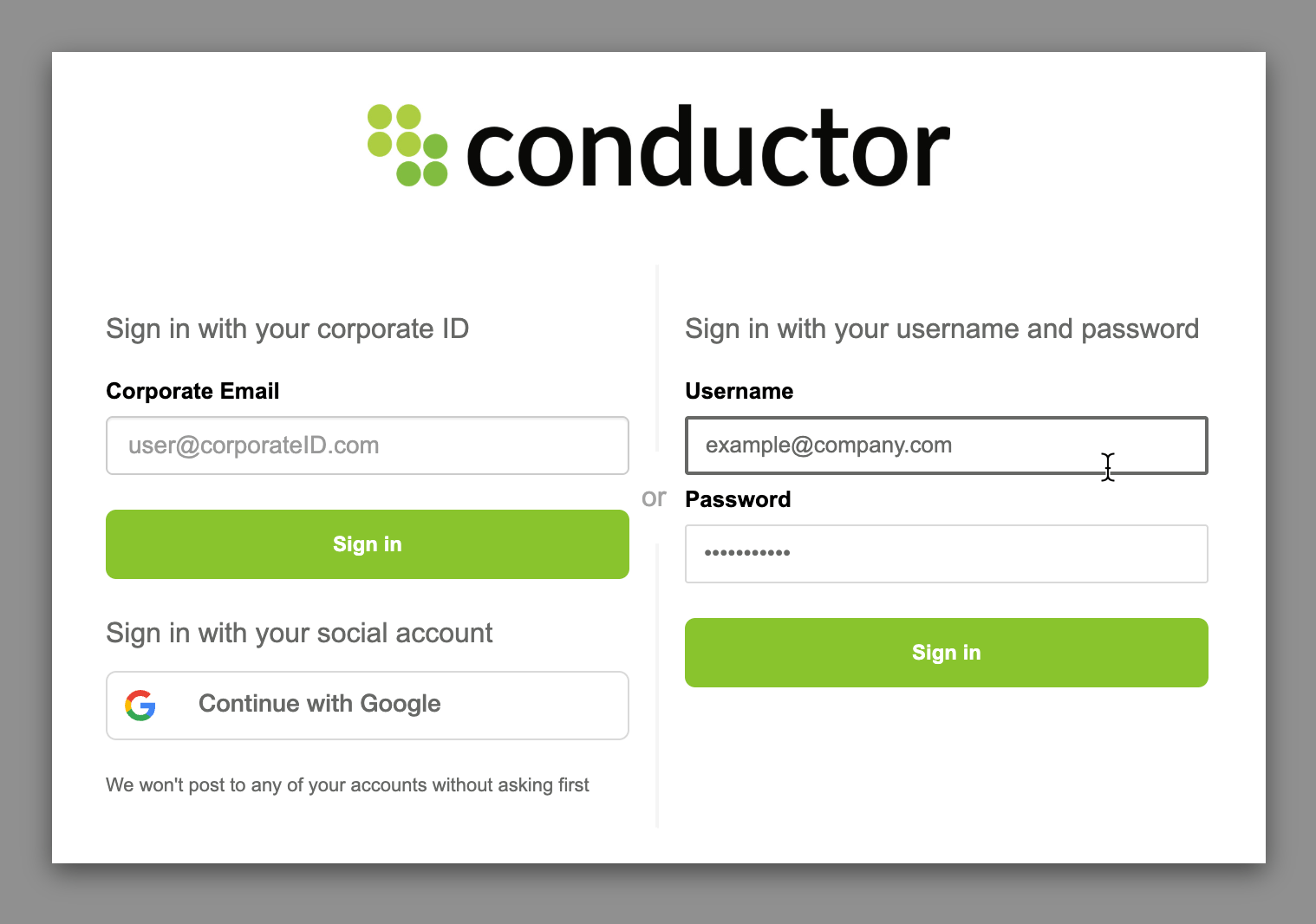
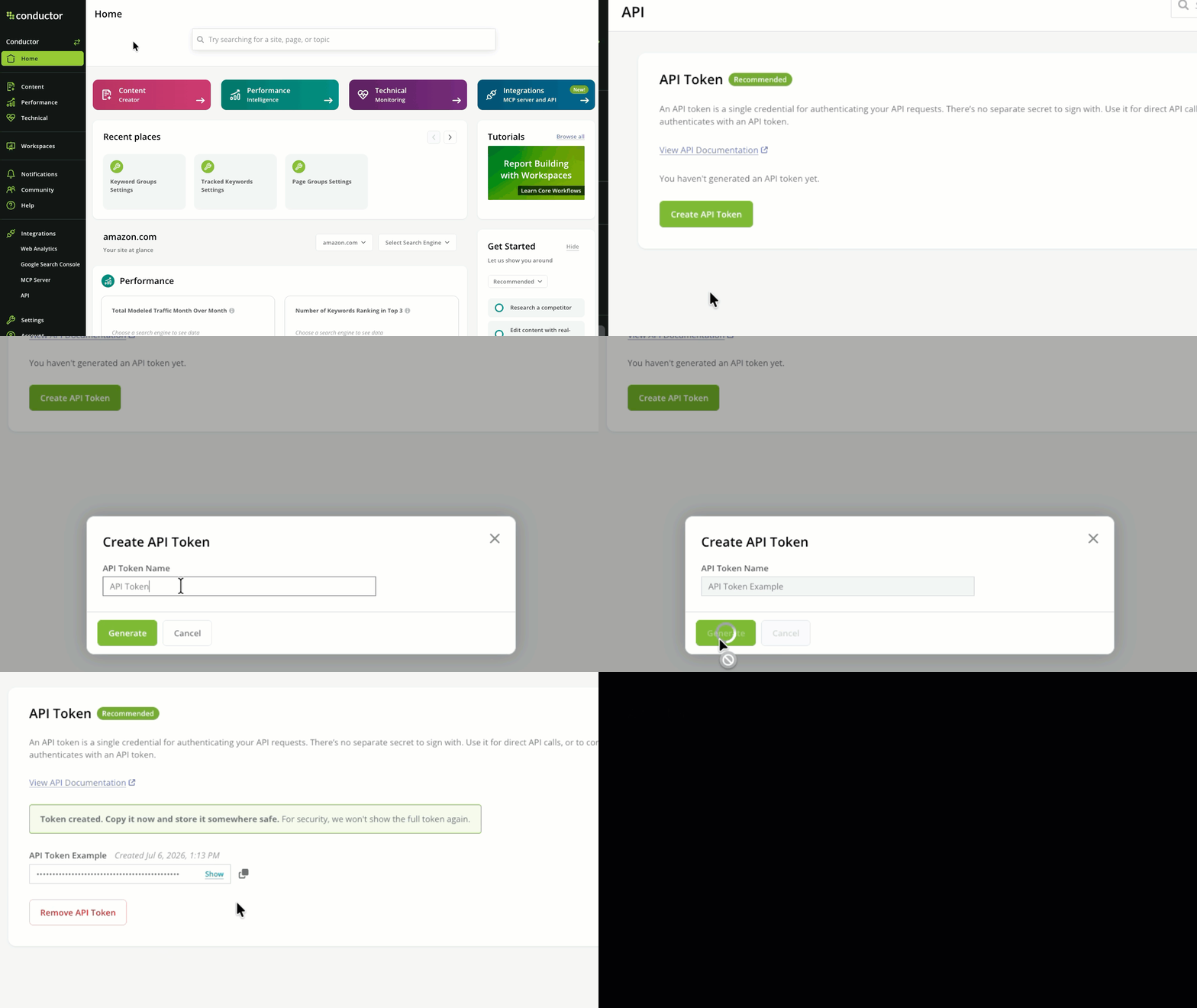
Examples for connecting Conductor’s MCP to other platforms
The examples below show how to connect each platform to Conductor’s MCP server. In every case, the MCP server URL ishttps://mcp-universal.conductor.com/mcp/v3. Most of these platforms authenticate with the API token generated above—the exception is Google Gemini Enterprise, which supports only OAuth.
These directions describe the general approach for each platform. The exact labels and menu locations may change as these third-party tools evolve—consult each platform’s own documentation to be sure.
Connect Abacus with Conductor
Connect Abacus with Conductor
Abacus.AI’s ChatLLM lets you register remote MCP servers from its agent settings.
- In Abacus.AI, open Agent Settings and select MCP Server Config from the sidebar.
- Add a JSON entry for Conductor that includes the server URL and an
Authorizationheader carrying your API token:
- Save the configuration. Abacus queries the server and lists Conductor’s available tools.
Connect Google Gemini Enterprise with Conductor
Connect Google Gemini Enterprise with Conductor
Gemini Enterprise connects to Conductor through a Custom MCP Server data store. Unlike the other platforms on this page, Gemini Enterprise offers only No authentication or OAuth 2.0—there’s no field for a Bearer token or a custom header—so this connection uses OAuth rather than your Conductor API token.
Get your client secret from Conductor
The client secret for the Gemini Enterprise OAuth client isn’t published on this page. Contact Conductor to request it before you start—you’ll enter it when you create the data store.Prerequisites
Gemini Enterprise blocks custom MCP data stores by default. Before you begin, a Google Cloud administrator must:- Set the Disable custom MCP server connector for Gemini Enterprise organization policy constraint to Off (Not enforced). This requires an Organization Policy Administrator.
- Add all three of Conductor’s hosts to the
allowedEgressFqdnsparameter in your egress domain policy:mcp-universal.conductor.com,auth.conductor.com, andprod-conductor.auth.us-east-1.amazoncognito.com. Miss either of the last two and the OAuth exchange fails even though the MCP server itself is reachable. - Add
custom_mcpto the allowed data sources, if project enforcement is enabled or the project is protected by VPC Service Controls. - Grant the Discovery Engine Editor (
roles/discoveryengine.editor) role to whoever creates the data store.
Create the data store
- In the Google Cloud console, go to Gemini Enterprise.
- In the navigation menu, click Data stores, then click Create data store.
- On the Select a data source page, enter
Custom MCP Serverin the Search sources field, then click Add MCP server on the card that appears. - In the Authentication settings section, select OAuth 2.0 and complete the form:
- MCP Server URL:
https://mcp-universal.conductor.com/mcp/v3 - Authorization URL:
https://auth.conductor.com/oauth2/authorize - Authorization URL Parameters: leave empty. Gemini Enterprise appends the standard OAuth parameters itself.
- Token URL:
https://prod-conductor.auth.us-east-1.amazoncognito.com/oauth2/token - Client ID:
2ff2jkrpif0dmb7meqc4tc0o4d - Enable PKCE Support: on. Conductor’s authorization server supports PKCE with the
S256challenge method—turn this off only if the token exchange errors. - Client Secret: [Enter the client secret you received from Conductor]
- Scopes:
openid profile email
- MCP Server URL:
- Click Verify Auth, then click Continue.
- Select Multi-region as the location, enter a name in Your data connector name (for example,
Conductor), and click Create.
Enable Conductor’s tools
When the data store reaches Active, Gemini Enterprise imports Conductor’s tools but leaves them disabled.- Open your new Custom MCP data store.
- Click Actions > Reload custom actions to fetch the list of available tools.
- Select the tools you want, then click Enable actions. You can enable up to 100 at a time.
- Connect the data store to the app or agent that should use it. See Google’s guide to connecting a data store to an app for the steps.
- Authorize the connection: open the app, select Manage your data, click Enable actions next to the Conductor data store, and sign in with your Conductor credentials.
Connect Librechat with Conductor
Connect Librechat with Conductor
LibreChat connects to remote MCP servers through the
mcpServers block in your librechat.yaml file.- Open your
librechat.yamlconfiguration file. - Add Conductor as a
streamable-httpserver, passing your API token in theAuthorizationheader. SetrequiresOAuth: falseso LibreChat uses your header instead of attempting an OAuth flow:
- Restart LibreChat so it picks up the new server, then select Conductor in the MCP menu.
Connect Lovable with Conductor
Connect Lovable with Conductor
Lovable connects to MCP servers as “chat connectors.” Custom MCP servers are available on paid plans.
- In Lovable, open Connectors and go to Chat connectors.
- Click New MCP server.
- Enter a Server name (for example,
Conductor) and set the Server URL tohttps://mcp-universal.conductor.com/mcp/v3. - Under Authentication, choose Bearer token or API key and paste your Conductor API token.
- Click Add server. Conductor now appears in your list of chat connectors.
Connect n8n with Conductor
Connect n8n with Conductor
In n8n, use the MCP Client Tool node to expose Conductor’s tools to an AI agent.
- Add an MCP Client Tool node to your workflow and connect it to your AI Agent node.
- Set the SSE Endpoint (server URL) to
https://mcp-universal.conductor.com/mcp/v3. - Set Authentication to Bearer Auth, then create a credential whose token is your Conductor API token. If you prefer to send the token yourself, choose Header Auth and add an
Authorizationheader with the valueBearer YOUR_CONDUCTOR_API_TOKEN. - Save and execute the workflow. The agent can now call Conductor’s tools.
Connect Notion with Conductor
Connect Notion with Conductor
Notion supports custom MCP servers for Custom Agents once an admin enables the feature.
- A workspace admin enables custom connections in Settings > Notion AI > AI connectors > Enable Custom MCP servers.
- Open your Custom Agent’s Settings and go to Tools & Access.
- Click Add connection > Custom MCP server.
- Enter the MCP server URL
https://mcp-universal.conductor.com/mcp/v3and a display name (for example,Conductor). - When prompted for authentication, choose header-based auth and add an
Authorizationheader with the valueBearer YOUR_CONDUCTOR_API_TOKEN. - Click Save. Conductor’s tools become available to the agent.
Connect Replit with Conductor
Connect Replit with Conductor
Replit Agent can connect to any MCP server you add by URL.
- In Replit, open the MCP Servers settings pane and click Add MCP server.
- Paste the server URL
https://mcp-universal.conductor.com/mcp/v3. - Open Advanced settings and add a custom header:
- Key:
Authorization - Value:
Bearer YOUR_CONDUCTOR_API_TOKEN
- Key:
- Click Test & save. Once the connection succeeds, Conductor appears under MCP Servers and its tools are available to Agent.
Change Log
- 2026-09-17 · Added — Google Gemini Enterprise can now connect to Conductor’s MCP as a Custom MCP Server data store. Gemini Enterprise supports only OAuth 2.0, not Bearer or Header auth, so it uses OAuth client credentials issued by Conductor rather than an API token.